
Today we have the opportunity and the pleasure of interviewing the young artisan cheesemaker Zoltán Horváth, a native of the city of Székelykeresztúr, where he has turned his house into a factory of artisan cheeses, butter and joghurt. Where we have had the opportunity to tastethem and I can assure you that they are really delicious.
 Some of the varieties of dairy that the young man produces
It is known for having some of the best cheeses in the entire area. And we start by asking:
Q: Did your ancestors also make cheese?
A: I am the first in the family to be involved in making dairy products
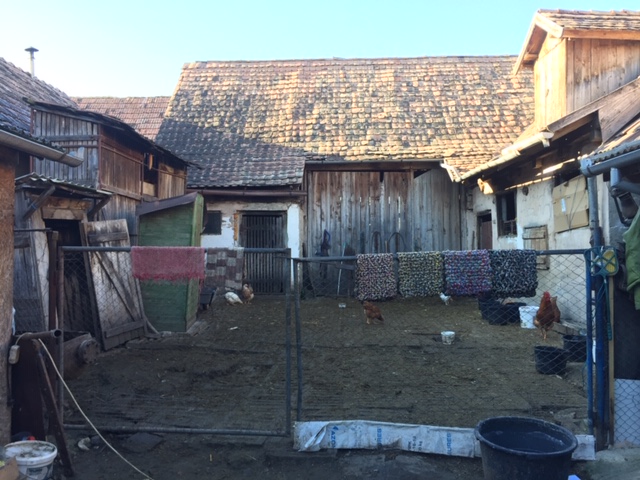 View of the main entrance where the animals are
Q: How long have you been making cheese?
A: I have been working with it for over 1 year.
Q: Where do you sell your cheese? Do you have a market stall?
A: I sell my products in the city market (Saturdays in Strada Arany Janos 9), and we also deliver them to home on request.
Q: To make cheese do you use the products of your farm or do you buy something from others?
A: For the production of dairy products, I only process milk produced by my own livestock.
 Liters of milk stored for the production of cheese
Q: -Could you tell me a little about your day to day on the farm ?: How many people work with you?How many liters of milk do you use daily?How many kilos of cheese do you produce per week?
A: Animal husbandry is a family business with us, so we are the ones who do the work ourselves. We do not have employees, we only pay a worker for a day or two for some field work. From the morning and evening milking approx. we get 200 l of milk from the animals. We deliver 100 liters of milk to the residents of the city and the remaining 100 liters to produce dairy products. We make several types of dairy products: butter, cheese, telemea, cottage cheese and yoghurt. Their amount per week is approximately as follows:
-Butter – 40 pcs.
-Cheese – 20 kg.
-Telemea – 15 kg.
-Cottage cheese – 10 kg. • Joghurt – 15 l.
These can usually vary as needed.
 Stirring in the giant casserole for the subsequent preparation of the cheese
Q: Tell us about the difficulties you encounter every day
A: Because it is a family business, we have to maintain and do everything, as a result we often face machine failures that we need to fix, we don’t have a separate person for it, and this profession is highly dependent on the weather as not all weather is suitable for different jobs.
Q: You receive some help or subsidy for making this artisan cheese?
A: We did not get support for the production of handicraft products, we have implemented all the developments so far on our own.
 Poured into the container
Q: Has the health crisis affected you when it comes to continuing to market your cheese?
A: I think that the health crisis has not affected the marketing of our products, as we are talking about food, which people need even during the crisis.
 Pressing cheese to remove water
Q: How do you see your farm and your cheese in the future?
A: We are always on the lookout for further development and evolution so that we can work with modern tools.
 View of the fully pressed cheese awaiting drying
Q: Anything else to finish?
A: I love what I do and I think the future belongs to homemade products.
 Final result, just have to enjoy
Finally, we would like to publish where the cheese factory is located and the products that it currently has for sale, so that those interested can enjoy these wonderful dairy products like us.
